
A brain-based framework tells you what builds culture. Here's the exact method for turning it into a daily habit, one builder at a time.
When was the last time you read something that you knew you needed to implement, and had all the intentions of implementing, but never did? You nodded along, then went right back to running meetings the way you always had, and that's not a failure of willpower. We're inundated with so much on a daily basis, and when everything is a priority, nothing is a priority.
This list was meant to be stripped apart one by one, not digested and internalized all at once. You can spend 5 minutes a day doing this, and over time, will have a lasting impact on you and your team.
The Top 5 Culture Builders vs. Top 5 Culture Crushers handout is built on the SCARF model, David Rock's research on the five things your brain treats as survival triggers at work: status, certainty, autonomy, relatedness, and fairness. Knowing the five triggers is step one. Changing how you show up in meetings is a different problem, and it needs a different kind of instruction than "be more aware of this." It takes intentional effort.
That's what this post is about: the specific method for taking the builder side of the framework off the page and into your calendar, one piece at a time.
The Quick Answer
Scan the five builders and rate yourself from strongest to weakest. Take your strongest one, write it on a note card, and keep that card visible. Read it before every meeting or conversation. Set a calendar reminder for one month out, so when it hits you make an honest call: move to the next builder, or keep working the one you've got. Give more time to whichever ones you rate weakest as you work down the list.
That's it, that's the whole method. The rest of this post is about why each piece of it matters and how to do it.
What the Framework Is Built On
The five builders come directly from SCARF, five domains your brain monitors constantly, mostly without your permission, to decide whether a room feels safe or threatening:
- Status: whether you feel respected and valued relative to others
- Certainty: whether you can predict what's coming next
- Autonomy: whether you have a sense of control over your own choices
- Relatedness: whether you feel like you belong, like people are "with" you rather than against you
- Fairness: whether exchanges and decisions feel just
Every one of those triggers can be built up or torn down in the space of a single conversation. The handout pairs each trigger with a "how to build it" habit and a "what crushes it" habit, so you can see both sides side by side. This post focuses on the builder side, the habits that create safety, because that's where the note card method comes in.
Why Rating Yourself Comes First
You cannot build all five at once, and trying to is exactly why most people abandon frameworks like this after a week. Rating the five builders from strongest to weakest does two things. It tells you where you already have some natural instinct to build on, and it tells you where the real gaps are, the ones that are probably showing up as friction on your team right now without you fully naming them.
We have to be honest where we are with this list, not aspirational. This isn't a test you can fail. It's just data about how you actually operate today, not how you'd like to think you operate, or how you operated that one time. It's about what you do consistently to build your leadership muscles.
The Note Card Method, Step by Step
1. Scan the five builders and rate them, strongest to weakest. Read through status, certainty, autonomy, relatedness, and fairness on the builder side of the handout. Rank them for yourself. Don't overthink it. Your gut answer is usually right.
2. Start with your strongest. Write it on a note card. This is the part people want to skip. It feels more productive to start with your weakest link and go fix it. Don't. We're using the snowball effect, so starting with what you're already decent at builds momentum and confidence fast, and it gives you a concrete win to point to before you take on harder terrain.
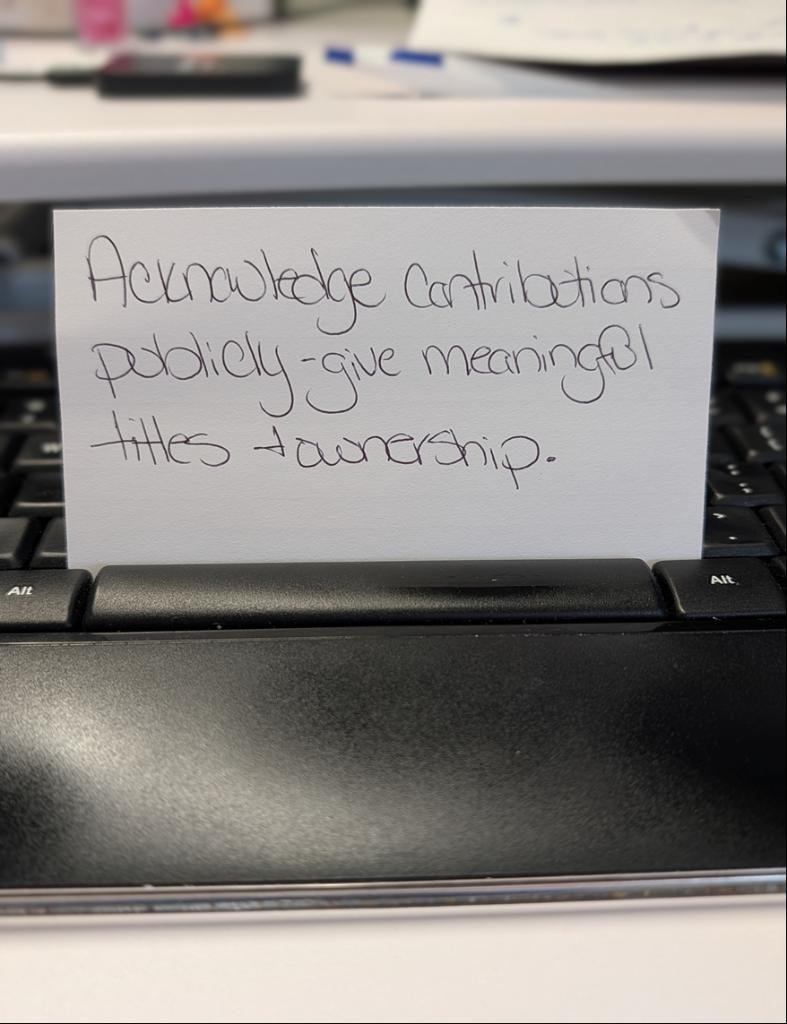
3. Keep the card visible. Read it before every meeting or conversation. I put mine in my keyboard at the end of each day so it's the first thing I see in the morning. The point of the card isn't to inform you, you already know what's on it after the first read. The point is to interrupt autopilot for ten seconds before you walk into a room, so the habit is loaded in your head at the exact moment you need it, not sitting in a drawer where it can't help you. You could even put random reminders on your calendar to read the card so it takes you out of that autopilot.
4. Spend at least a month on each builder. Give more time to the weaker ones. A month is the floor, not the target. Some builders will click faster than others. The weaker ones, the ones you rated near the bottom, deserve more runway, because you're not just adding a habit there, you're overriding an existing one. That takes longer, and it should.
5. Set a calendar reminder for one month out. The day you write your first card, open your calendar and set a reminder thirty days out. When it goes off, you've got two options: swap in your next builder, or admit this one still needs more of your attention and keep the same card up a while longer. Either answer is fine. The reminder isn't there to force you to move on, it's there to make sure you actually check in, instead of letting a card quietly go stale on your desk for four months without you noticing.
Why the Pacing Matters More Than the List
Run the math and this is a five-to-eight month practice, not a five-minute read. Culture doesn't move because a team saw a nice one-pager once. It moves because a leader repeated one specific behavior often enough, for long enough, that it became the water everyone else was swimming in. The quote on the handout says it plainly: your team isn't catching what you say your culture is. They're catching the habits you practice, every single day. A month per builder is roughly how long it takes for a practiced behavior to stop feeling like an assignment and start feeling like who you are.
What's Next
This is one of two ways to use the framework. The other approach works in the opposite direction: before a specific meeting or conversation, scan the five crushers instead, ask yourself which domain might be under threat in that exact room, and design your approach around protecting it. That's a sharper, situational tool, and it's worth its own post, so I'll cover it next.
Frequently Asked Questions
What is the SCARF model? SCARF is a framework developed by David Rock of the NeuroLeadership Institute describing five domains, status, certainty, autonomy, relatedness, and fairness, that the brain treats as core social needs. When any of them feels threatened, people respond as if they're under physical threat: defensively, cautiously, or disengaged. When they feel supported, people collaborate and contribute more freely.
How long should I spend on each culture builder? At least a month. Spend longer on the builders you rated as weaker, since those require replacing an existing habit rather than reinforcing one you already lean on.
Why start with my strongest builder instead of my weakest? Starting with a builder you already have some instinct for creates a fast, visible win and builds the confidence and momentum you'll need before tackling the harder, weaker areas.
Do I need to use a physical note card? The format doesn't matter as much as the visibility and the repetition. A note card works because it's tangible and easy to glance at right before a meeting. A phone lock screen or a sticky note on your monitor works the same way. What matters is that you actually see it, and read it, before every conversation, not just once in a while.
What happens when my one-month reminder goes off? You make a quick call: move to the next builder on your list, or keep the one you have if it still needs work. There's no wrong answer. The point of the reminder is just to make sure the check-in actually happens, instead of the card quietly gathering dust on your desk.
Culture Isn't a One-Person Job
Try this yourself before you hand it to your team. Rate the five builders, pick your strongest, put it somewhere you'll actually see it, and set that first reminder before you close this tab. If you want to go deeper on this with your team, I'm always up for a conversation, or a workshop if you want to take it further. Reach out anytime.
Explore Topics
Written by
Stephanie Hammond
Content creator and writer sharing insights and stories.


